
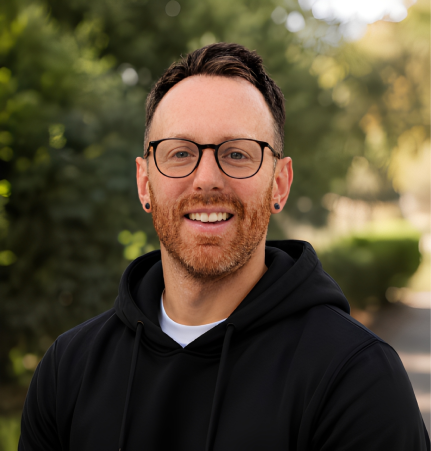
I’m James, a BACP Registered Psychotherapeutic Counsellor offering online counselling to adults across the UK.
Before becoming a counsellor, I spent twenty years working in corporate environments.
For much of that time, I was good at what I did. I progressed, took on responsibility and became someone people could rely upon. From the outside, things looked reasonably successful.
But being able to function well doesn’t necessarily mean everything feels right underneath.
For a long time, I became very good at pushing through stress, meeting expectations and carrying on. Eventually, burnout forced me to stop and pay attention to what was happening internally.
That became an important turning point in my life.
What I’m like as a counsellor
I know how vulnerable it can feel to sit opposite another person and talk honestly about things you may barely admit to yourself.
So I don’t expect you to arrive knowing exactly what’s wrong, having the right language or knowing what you want from therapy.
We can work that out together.
I’m warm and accepting, but I’m not a passive therapist. I listen carefully and take time to understand your experience, while also being willing to notice patterns, ask difficult questions or gently challenge something when I think it might be helpful.
There can also be humour in therapy. The work can be difficult and emotional, but I don’t believe every minute of a counselling session needs to feel heavy.
Above all, I want you to feel able to bring the version of yourself that actually exists — rather than the version you think you’re supposed to present.
My own experience of counselling
Seeking counselling wasn’t something that came naturally to me.
Like many people, I’d become accustomed to dealing with things myself. Therapy gave me somewhere I didn’t have to do that.
It helped me begin recognising patterns I’d carried for years, questioning some of the beliefs I’d developed about myself and becoming more aware of how much of my life had been shaped by other people’s expectations and approval.
Perhaps most importantly, it helped me reconnect with parts of myself I’d stopped listening to.
That process eventually contributed to a much bigger question:
What did I actually want my life to be about?
I didn’t emerge from counselling with everything figured out. I don’t think that’s really how change works.
What I developed instead was a more honest relationship with myself — greater curiosity about my feelings, more compassion towards the different parts of me, and greater trust in my own experience.
My own experience of therapy ultimately became part of what led me towards becoming a counsellor.
How I work
My therapeutic foundation is person-centred.
At its heart, this means I believe you are the person who ultimately has to decide what is right for your life. My role isn’t to diagnose your personality, hand you a set of instructions or tell you what decisions to make.
Instead, we try to understand your experience together.
Sometimes that means exploring what’s happening in your life right now. At other times, we might become curious about earlier experiences and the patterns or beliefs that developed from them.
I’m particularly interested in the different parts of ourselves that can pull us in competing directions.
You might have one part that desperately wants something to change and another that’s frightened of what change could mean. One part might be exhausted and want to stop, while another insists you need to keep achieving. One might understand intellectually that you’re doing enough while another relentlessly criticises you.
Rather than treating those parts as problems to eliminate, we can become curious about where they came from, what they’re trying to protect and what they might need.
Self-compassion is also an important part of how I work. Many of the people I meet are remarkably understanding towards other people while holding themselves to very different standards.
Learning to relate to yourself differently can be powerful therapeutic work.
Where appropriate, I may also draw on mindfulness and other therapeutic approaches, but I don’t work from a rigid programme. What we do should make sense for you.
Training, experience, and professional grounding
I qualified with a CPCAB Level 4 Diploma in Therapeutic Counselling in 2024 and completed my CPCAB Level 5 Diploma in Psychotherapeutic Counselling in 2025.
I am a Registered Member of the British Association for Counselling and Psychotherapy (BACP) and work within its ethical framework.
Alongside my private practice, my counselling experience has included working with Mind (Herefordshire) and supporting people experiencing a wide range of emotional and mental health difficulties.
My continuing professional development has included training in:
- trauma-informed practice;
- substance use interventions;
- suicide prevention and awareness.
I also hold a Meditation Teacher Diploma from the British School of Meditation and have practised meditation and mindfulness for many years.
I undertake regular clinical supervision and ongoing professional development as part of maintaining safe and ethical practice.
A little more about me
Counselling is important to me, but it isn’t my whole identity.
Outside the therapy room, music has been a significant part of my life for many years. I’m a musician and have spent a considerable amount of time playing, recording and performing.
I value creativity, curiosity and humour, and those qualities inevitably influence the person I am in the counselling room too.
I don’t believe therapy requires either of us to stop being human.
Could we work well together?
Finding the right counsellor isn’t simply about qualifications or therapeutic approaches.
The relationship matters.
You need to feel that you’re talking to someone you can gradually trust enough to be honest with — including about the parts of yourself you might normally hide, minimise or explain away.
If something about the way I work resonates with you, we can start with a free introductory call.
There’s no obligation to continue afterwards. It’s simply an opportunity to talk briefly about what brings you to counselling, ask any questions you have and get a sense of whether working together feels right.